World Cup, tourism, and product: when opportunity arrives before the roadmap
The World Cup has a strange way of accelerating markets. A country many people could not place on a map appears for ninety minutes in front of millions. The next day there are searches, articles, videos, agencies improvising packages, airlines watching routes, and local businesses wondering whether the spike will become anything real.
Cabo Verde is the current example. Croatia and Morocco are the reminders that the pattern does not start or end there.
The first signal is already concrete: TUI searches doubled, Expedia saw an 800%+ jump in U.S. searches, and Japan-based interest rose 110%. The deeper problem is also clear: Cabo Verde receives around 1.2 million tourists a year, depends heavily on European all-inclusive packages, and concentrates much of its visitor activity in Sal and Boa Vista.
That is the interesting part. The World Cup does not deliver a strategy. It delivers a window.
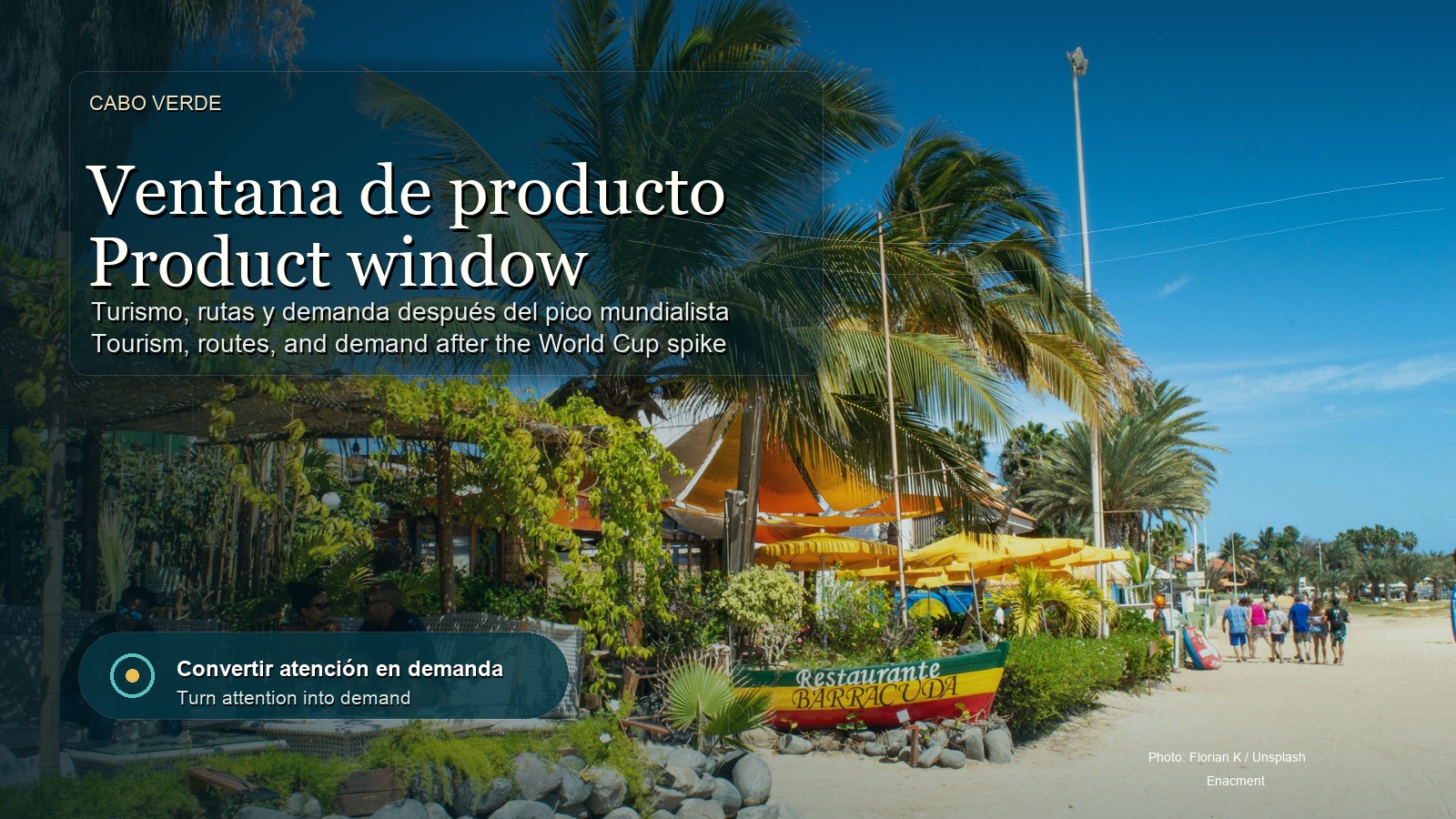
!Editorial image of Cabo Verde as a tourism and product opportunity window
Base photo: Florian K / Unsplash. Editorial composition by Enacment; figures are directional evidence, not proof of single-cause attribution.
The signal is not the result
Croatia reached the 2018 World Cup final and posted a record tourism year in 2019: its Tourism Ministry reported 20.1 million arrivals and 107.03 million nights, up 5% and 2% year over year. Croatia's statistics office also recorded 19.6 million arrivals in commercial accommodation, with 91.2 million nights and growth versus 2018.
That does not mean football caused everything. That would be lazy. Croatia already had a tourism product, brand, routes, hotels, recognizable cities, and a commercial machine. The World Cup amplified something that could already receive demand.
Morocco shows another angle. After its historic 2022 semifinal run, the country did not treat attention as a one-off applause line. It folded it into a longer agenda: tourism, airports, hotels, country brand, and preparation to co-host the 2030 World Cup. In 2024, Morocco's Tourism Ministry reported 17.4 million tourists, 20% more than in 2023 and 35% above 2019; tourism revenue reached 112 billion dirhams.
Again: not all of that is football. But the pattern matters. Attention works when it finds a system ready to absorb it.
Cabo Verde is in the uncomfortable moment
Cabo Verde is still in the hardest part: the window is open, but capture is not guaranteed.
Our read is that the country has an opportunity to diversify source markets, attract more U.S. demand, and push tourism beyond the all-inclusive package. It also has bottlenecks: air capacity, hotel supply, geographic concentration, dependence on foreign operators, and limited local spending.
!English visual with tourism signals from Cabo Verde, Croatia, and Morocco around World Cup attention
In product language, the problem is not "run a campaign." The problem is designing a system that turns curiosity into demand the business can serve.
Someone who just discovered Cabo Verde does not need an institutional brochure. They need practical answers: how to get there, when to go, which island to choose, how much it costs to move around, how easy payment is, what exists beyond the resort, and how trustworthy booking feels. An agency needs inventory, conditions, routes, and timing. An investor needs signals of demand, regulation, infrastructure, and operating capacity.
If those answers do not exist in a clear experience, the attention gets wasted.
The playbook is product, not marketing
The lesson for any company is direct: unexpected opportunity is captured with reusable capabilities, not last-minute heroics.
!Product playbook for turning a World Cup spike into captured demand
When the market moves, product needs to answer four questions quickly:
1. What signal changed? Search growth is not the same as more quotes, calls, bookings, or abandonment.
2. What experience is missing? Landing page, content, quote flow, calculator, demo, FAQ, page by market, or in-product module.
3. What operation supports the promise? Sales, support, availability, inventory, pricing, legal, CRM, analytics.
4. What data decides the next move? Conversion, lead origin, intent, acquisition cost, response time, operating bottleneck.
This applies in tourism, banking, education, retail, and B2B software. The window can come from a World Cup, a reform, a logistics crisis, a new regulation, or a cultural conversation. The mechanism is the same: market intent changes before the roadmap is ready.
What to build before the spike
The smart part is not guessing which event will happen. It is having pieces that can be activated when something does happen.
For a tourism destination, that can mean pages by origin market, comparison content, connected inventory, agency forms, booking flows, route maps, real availability, and demand dashboards.
For a B2B company, it can mean a landing page by industry, a fast diagnostic, ready-to-use cases, commercial follow-up connected to CRM, analytics events, lead-scoring criteria, and an editorial approval process that does not take two weeks.
The point is not to build everything. It is to avoid starting from zero every time.
Croatia shows that exposure performs better when there is already a mature tourism machine. Morocco shows that a World Cup run can connect with an infrastructure and country-brand agenda. Cabo Verde shows the prior moment: attention has arrived, but it still has to become product, operation, and learning.
Attention does not pay invoices. The system that captures it does.